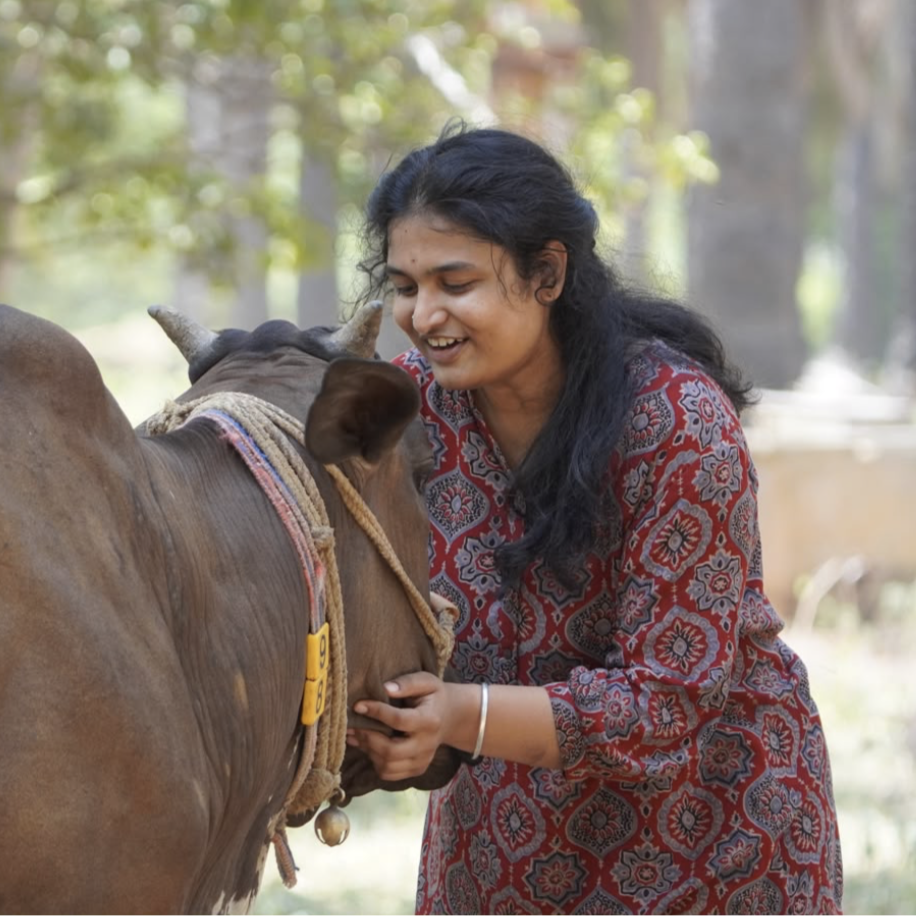
Practicing Survival, Hinduism, and Health
During our time at the CALORIE exhibition in the Science Gallery Bengaluru, in July of 2025, we crossed paths with Anjani Kumari. The CALORIE exhibition investigated how food is flattened and quantified despite its intimate relationship with the body and our surrounding environments. Having discovered the Museum of Edible Earth online, Anjani traveled to the exhibition to meet and speak with us. Anjani is an avid earth-eater whose passion for earth is intrinsically entangled with the environmental, religious, and nutritional health landscapes of Andhra Pradesh’s Chirala coastal zone, where she grew up in Southern India.
Upon first meeting Anjani Kumari, she presented us with Termite Clay, an earth whose consumption is mostly mediated by Hinduism. She shared that Termite Clay is actively used during the Hindu festival Nagula Chaviti. Termite Clay occurs naturally in Andhra Pradesh’s dry landscape as earth that is mounded by termites. Due to the clay’s humid and hollowed interior, these termite mounds often house and serve as breeding grounds for snakes, which additionally hold spiritual and mythical significance within Hinduism. The earth’s ecological value thus lends itself perfectly to Nagula Chaviti’s celebration of the ‘Nag Devatas’ serpent deities, and temples are constructed around the termite mounds made into statues of snakes.
Anjani explained that due to mythological tales that say local serpents enjoy milk, it is customary to “pour milk into these termite mounds like offering milk to the snake, which we treat as a god in our local area. Then people tell their wishes and pour milk into the mound. It’s like a wishing well, but a wishing termite mound.” This belief draws crowds to the termite mounds every year, with some celebratory rituals even ending with the consumption of the termite clay itself. Anjani went on to share that “[Termite Clay] is eaten because it helps us build immunity during the winter season.”
As for Termite Clay’s taste, Anjani describes it as “slightly rusty” due to its minerally dense composition, with high amounts of calcium, magnesium, and iron. Not only this, but Anjani points out that the clay’s gritty, sandy texture is owed to the Chirala region’s coastal landscape. The same reasoning applies to its darkish brown color. When Anjani and the Museum first tasted Termite Clay together, Kumari expressed that through eating the earth, “we are connected to our culture.”
Since this first encounter, the MEE studio recently received a package of gifted Roasted Clay, River Clay, and Fuller’s Earth samples from Anjani, we celebrated their placement in our archive by speaking with Anjani herself to better understand these three particular samples as well as her own experience as an earth-lover. As it turns out, Anjani’s personal and environmental relationship with geophagy has profoundly shifted.
masharu studio: Tell me about yourself – how did you come to discover geophagy?
Anjani Kumari: As a kid, like everyone else, I used to eat these slate pencils and chalk. One day, like, for Vinayaka Chavti, we make idols of Lord Ganesha with clay. And during the preparation of that clay, out of curiosity – because it smells so good, soaking the dry clay is one of the best smells out there – I was tempted and I tasted it. It was incredible! So I started tasting different kinds of clays, like red clay, black clay, termite clay. Like that, I started tasting everything. I loved everything.
masharu studio: Tell us about the three samples you sent us, Roasted Clay, Fuller’s Earth, and River Clay. How are they prepared, consumed, and where did you find them?
Anjani Kumari: Roasted clay (Nakumatt) is a Gujarati staple. They sell it on the street – like a common street food – in Western India. Very few people actually know about it in Southern India, but you can find it on the internet. It’s heavily roasted, so it has a signature smoky aroma and crunchy texture.
Fuller’s Earth is from North India. I’m from South India. Fuller’s clay, also known as Multani Mitti, is actually used for skin cleansing. It’s a type of aluminium silicate clay which holds a prominent place in traditional Indian wellness and Ayurvedic practices. But it has such a buttery and soft taste, people also like to eat it. Some people roast it and eat it. Some people soak it and eat it. […] Some people prefer Fuller’s Earth raw, some people prefer it roasted. Most of the people eat it raw only.
River Clay, it’s actually used for mud baths in Ayurvedic Therapy. People don’t know much about it. Only the farmers’ community know about it. They go into the rivers and collect it. It’s actually very nutrient dense, very mineral dense. It’s perfect for gardening and good for skin also. You can use it on your skin, like Fuller’s Earth. It’s also easy to shape, making it perfect for pottery and construction use.
masharu studio: What does River Clay taste like?
Anjani Kumari: It smells and tastes like moss. It has this chocolatey mossy taste. It’s very buttery also.
masharu studio: Where is this river?
Anjani Kumari: Nearby rivers. Like the Godavari river, the Krishna river, and the Kaveri river. Some people collected it for me.
At this point in our conversation, Anjani revealed how her own health journey has made for a conflicting experience with geophagy. While Anjani still expresses how these samples reflect the occasional local practices of geophagy, she urges us to grasp their simultaneous reflection of global communities’ struggle with geophagy and nutrition more generally.
masharu studio: These samples, especially River Clay, feel very locally tied. Do you think that eating earth gives you more of a personal relationship with your environment?
Anjani Kumari: No, I don’t think so. That smell of River Clay, we get after the first rain – petrichor – most people like that smell and stop there. But the people with this habit of geophagy or Pica disorder, they connect, they eat it because they have deficiencies. We shouldn’t connect ourselves with earth by eating it. We should connect ourselves to earth by respecting it, by keeping it clean. Eating it just shows that it’s clean.
Two years back, I had anemia which gave me severe cravings for all this clay, chalk, slate pencil, everything… Then I started researching what this condition is. I heard about Pica disorder, but at the same time, I also came across Dr. masharu and the Museum of Edible Earth. I thought: people are eating edible earth, so I can also eat this. I was reducing my normal food intake and eating so much Fuller’s Earth and roasted clay, I got poisoning. But now I want people to have a healthy connection to geophagy. You can taste different kinds of earth, but there should be a limitation, right?
masharu studio: I think you’re right that geophagy relies on our environment staying clean. The purpose of geophagy is also for us to have a connection with the Earth.
Anjani Kumari: Yes. The clay and all earth surrounding us should be clean enough for us to eat. That is, I think, the main goal in geophagy.
masharu studio: Have you met people in your area who experienced the same thing?
Anjani Kumari: A lot of women. A lot of women in my circle, most of them have vitamin deficiencies and all. Because of that, the earth is incredibly delicious to them compared to other people. People with vitamin or mineral deficiencies find earth very delicious because it has raw minerals. The body thinks it’s consuming rich mineral food […] adults even eat earth because they still have that nostalgic, comforting feeling from the memory of eating it as a kid. So, yes, it’s only really good in moderation and it can say a lot about the health of certain communities as well.
Actually, in the region of Guntur in the South of Andhra Pradesh, there was this drought 150 years ago where people didn’t have any kind of food ¹ . At that time, people survived by eating soil, literal soil. So in our culture, eating soil or clay is not only a practice/eating disorder, but was also a matter of survival.
masharu studio: What does your relationship with geophagy look like now?
Anjani Kumari: I came to a conclusion that whenever I get a craving I’ll taste a little bit, like a half gram, and the flavor is nice. And I’ll stop it there.
Anjani emphasizes that this worldwide crisis of disordered geophagy requires a holistic and integrated approach. When asked what can be done to help the dilemma she describes, Anjani told us about her father.
Anjani Kumari: My father is a pulse diagnosis practitioner. He checks people and diagnoses their pulse for respiratory, digestive, or bacterial issues. Through the diagnosis, he’ll calculate what kind of issues you have, like in your respiratory system, or do you have your blood viscosity, all of this. He calculates everything and sees if you have any external infections from germs or bacteria, virus, fungus… He’ll check everything.
When I asked him what causes people to crave earth and other inedible materials, his answer was eye-opening. He told me almost everyone who experiences these cravings has underlying vitamin deficiencies and hormonal imbalances. So we came to a conclusion together: the people who have lower PH in their blood have more Pica disordered issues. This helped me understand that for some, geophagy is a coping mechanism rather than a curiosity.
But what about other people? They are not aware of it. In small villages or even in big cities Pica is actually a shameful thing. A proper adult eating clay, slates, chalk. They don’t come out and they don’t get help properly. So we want to make some videos used like awareness classes for people to know what you should eat and what you shouldn’t eat according to your body’s nature. We will plan a lifestyle system and food system for them.
masharu studio: So you and your dad are working together on this?
Anjani Kumari: Yes, my dad is working on this and I joined.
masharu studio: What would you say is your main message to the public?
Anjani Kumari: I think understanding this clinical reality made me realize that while tasting and exploring out of curiosity is fine, getting addicted and turning geophagy into a coping mechanism is not correct. People need to have enough awareness to recognise when their body is signalling a deeper medical deficiency, so they can seek actual treatment instead of relying on clay or soil.
Anjani and her father’s work contributes a valuable, nuanced perspective to the study of geophagy: how geophagy can be socio-environmentally traced as an indicator of health. Though Anjani’s main concern is with struggling global communities’ lack of awareness towards their bodies’ physical, nutritional health, her evolved views on the practice of eating earth fundamentally emphasize the urgent need to treat bodies and earth as interconnected systems that both require action to be kept healthy. Just as she advocates for education against Pica disordered eating, she is also advocating for her surrounding South Indian landscapes to be kept clean. Anjani’s story reminds us that the practice of geophagy relies on the cleanliness and health of planet Earth.
Her and her father continue to work towards making this necessary medical information accessible in Andhra Pradesh, and to the rest of the world, in hopes of helping individuals lead healthy physical, mental, and social lives.
To further explore the properties and religious purpose of Termite Clay, watch our Youtube video Termite Clay, India.
Interview and text by Louise Amarel
¹ “The Great Indian Famine of 1876–78 was one of the most devastating humanitarian crises in India’s colonial history. Affecting over 30 million people across southern regions like Madras, Mysore and Bombay, it claimed between six and ten million lives.” (Laakso, E. (2024) ‘No man need die of starvation: The Friend of India and Statesman as a critical voice during the 1876–1878 Great Indian Famine’. Available at: https://helda.helsinki.fi/bitstreams/0a08489e-9c6d-4851-ba43-51486d55fcc5/download